.jpg)
Published on 3.9.2026
European defense spending and readiness programs have expanded rapidly since 2022. At the same time, the term dual-use has become common across technology, manufacturing, innovation, and defense industries. Yet despite its growing popularity, there is surprisingly little agreement on what dual-use actually means.
Put simply, dual-use refers to technologies, products, goods, software, or systems that can serve both civilian and defense or security purposes.
European governments are investing more heavily in resilience and security, while startups, investors, and manufacturers are using the term to describe a growing range of products as dual-use.
Depending on who you ask, dual-use may refer to 1) export-controlled technologies, which is the most formal definition used by EU and export-control authorities, 2) technology or innovation that serves both civilian and military customers or an entire business strategy, for example where civilian product development’s speed and agility is leveraged and same technology is adapted for defense and security users.
A product can be one without being the other. As collaboration between commercial and defense sectors grows, having a shared understanding of the terminology matters.
It helps companies, investors, manufacturers, and public organisations communicate more clearly about technology readiness and compliance, as well as funding, manufacturing, and long-term product development. It can also help companies identify the right partners when moving from early innovation towards industrial-scale production.
The concept itself is not new. Historically, the term emerged after the Second World War to describe materials that could be used for both civilian and military purposes, particularly within the nuclear industry. Since then, the definition has expanded considerably.
Today, the European Union defines dual-use items as goods, software, and technologies that can be used for both civilian and military applications. The EU Dual-Use Regulation (EU 2021/821) applies this definition for export control and licensing purposes, with specific dual-use items identified through detailed control lists.
The United States draws the same line, but through jurisdiction rather than a single definition. Dual-use items fall under the Export Administration Regulations and appear on the Commerce Control List. Items designed specifically for military use fall under ITAR and the United States Munitions List instead. For Nordic manufacturers this matters in practice: it is why ITAR-free comes up as a sourcing requirement in defense-related supply chains, since an ITAR-controlled component carries US licensing obligations wherever it ends up.
Whether a specific product is a controlled dual-use item depends on its technical parameters against the control list, not on its market.
One common misconception is that dual-use products are purely military products. In reality, a lot of dual-use technologies were originally developed for commercial applications before finding value in defense or security. Rather than belonging to a single industry, dual-use increasingly describes technologies capable of solving problems across multiple operational environments.
Likewise, technologies originally developed for defense may later find applications in healthcare, infrastructure, industrial automation, or public safety. EU research policy describes these movements as spin-ins, where civil innovation finds defense applications, and spin-outs, where the reverse happens. This meaning has no formal test, which is why the term is applied broadly. In this wider definition, the defining characteristic is not the customer, but the ability to create value in more than one operational environment.
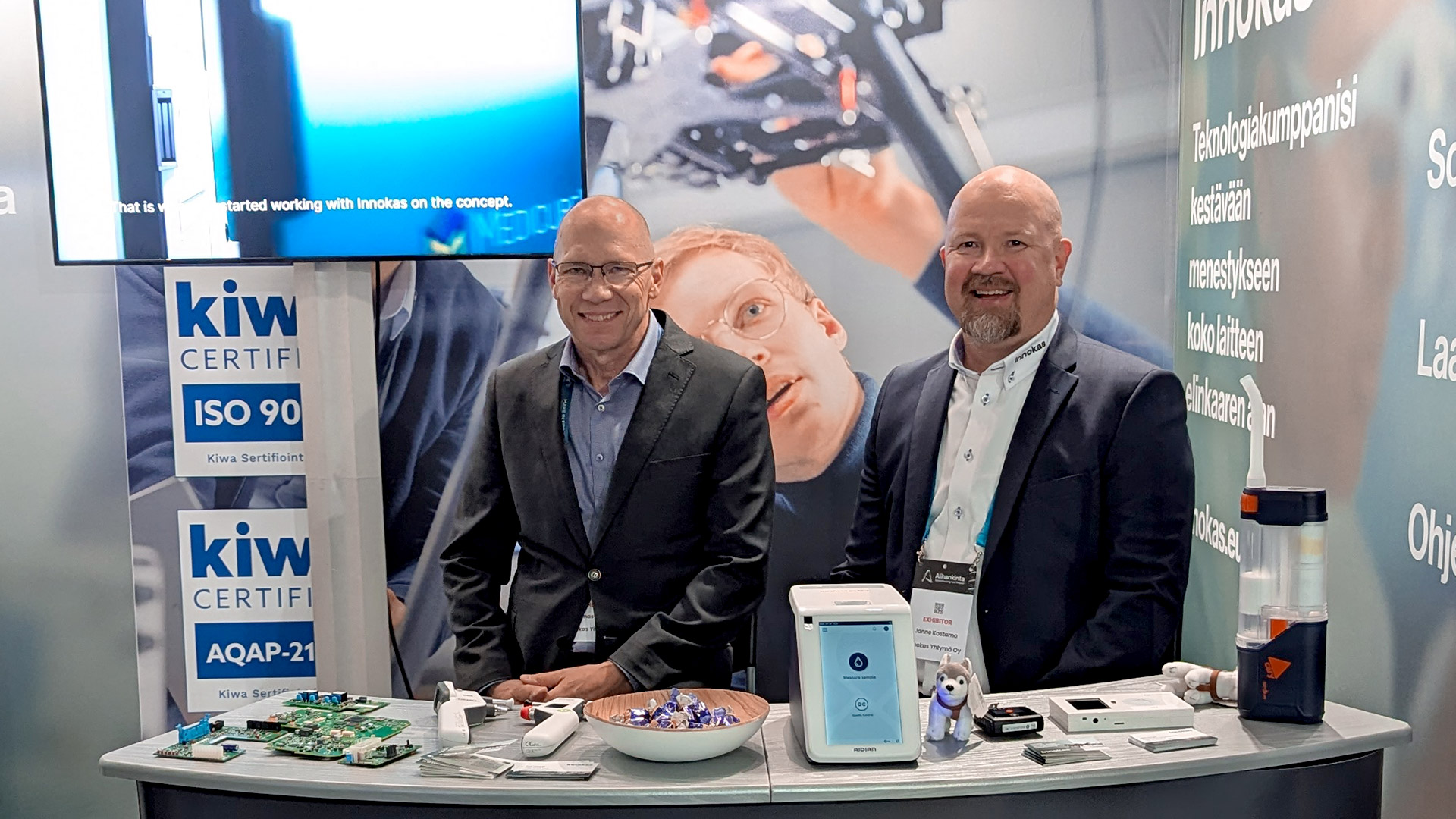
At Innokas, we use the term in line with the widely recognised industrial and defense definition. For us, dual-use refers to technologies, electronics, devices, software, and electromechanical systems that can be used in both commercial markets, such as medical technology, and defense or security applications.
Rather than separating these industries, we build on over three decades of experience with highly regulated, safety-critical products. The expertise and capabilities developed in demanding environments can be applied across industries and adapted to different technologies and applications.
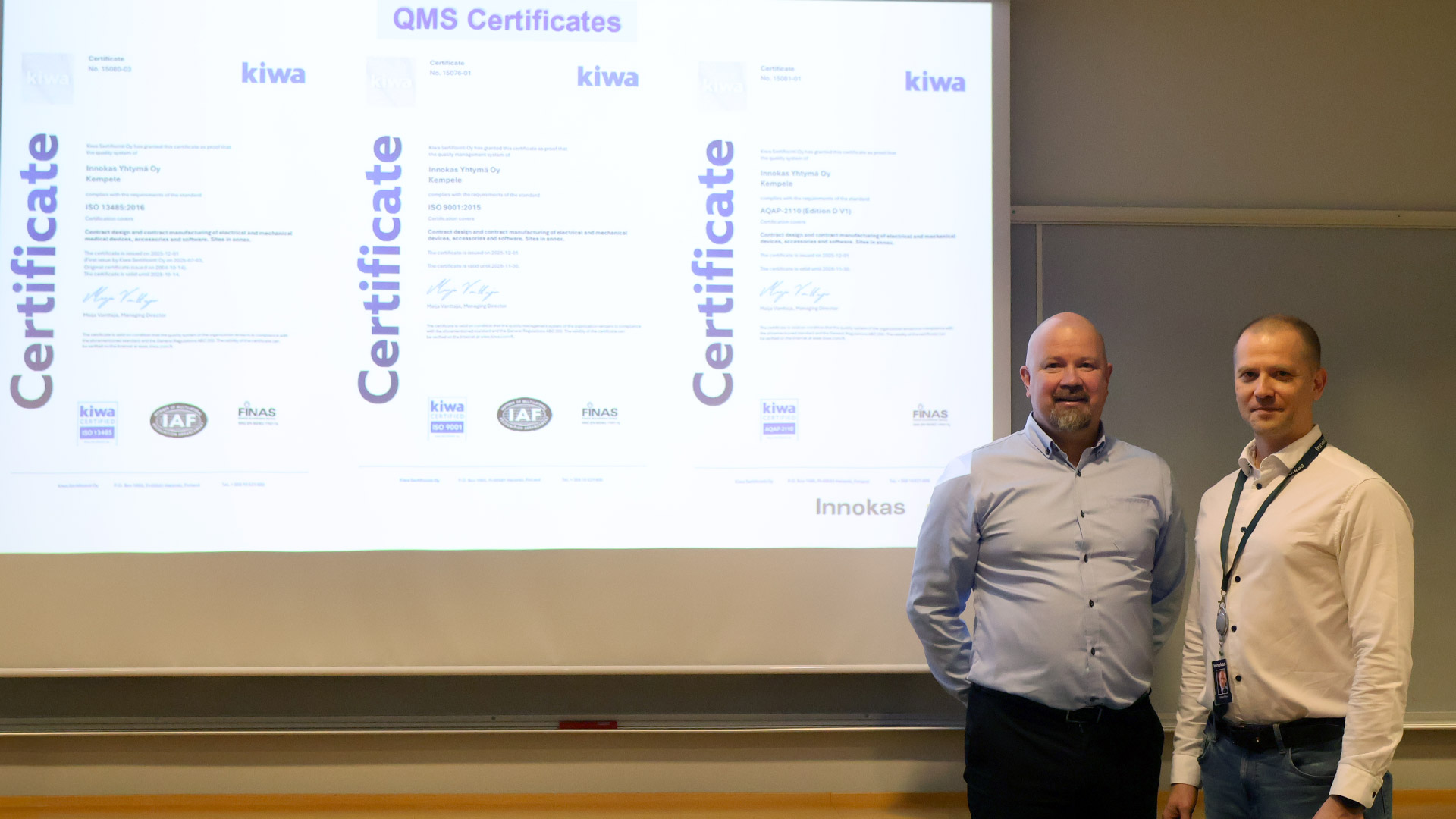
Many of the capabilities essential in medical device manufacturing are equally valuable in dual-use and mission-critical technologies. This applies to quality management and risk management, as well as the traceability, reliability, and documentation required throughout development and manufacturing. Our experience also extends to industrialisation, helping customers move from development towards scalable production. What does not transfer directly, Innokas has built the capabilities to address, like securing the AQAP 2110 certification in addition to our existing ISO 13485.
These capabilities allow us to support a wide range of advanced technologies. Our customers develop everything from sensors, autonomous systems, radar technologies, and communication equipment to medical solutions and other advanced electromechanical devices. We support their journey from prototype through to serial production.
Read more about defence and dual-use technologies and how we can support you.
The definition of dual-use will likely continue evolving alongside technology itself. Artificial intelligence, robotics, autonomous systems, advanced electronics, sensing technologies, and medical innovations increasingly operate across both civilian and defense environments.
Rather than representing two separate worlds, dual-use reflects the growing overlap between them, where reliable technologies developed for one purpose can create value in another.
For companies working with these technologies, it is important to understand what dual-use means in practice. The way a technology is defined and used can influence everything from product development and manufacturing to partnerships, funding, and market strategy.
Here’s a useful question: if serving defense customers requires you to redesign a product, create a separate supply chain and a separate quality system, you may still have a dual-use product but you may also be running two product businesses. Can you build both?
What does dual-use mean for your product?
If you are considering defence applications, industrialisation or scalable manufacturing, our experts can help you identify the requirements and practical next steps.

Here you can find more of our latest news and insights in this category.
Here you can find more of our latest news, tips and insights.
.jpg)
Here you can find more of our latest news and insights.
Here you can find more of our insights, news and tips.

Here you can find more of our insights, news and tips.
.jpg)








.jpg)