Published on 2.7.2026
When product demand increases, production must follow suit. More units, more floor space, more people. Still, this only scratches the surface and there are many more questions to answer regarding the product complexity, testing reliability and quality as the volumes increase. A small batch is world different from mass production, so everything that might have worked with the prototype batch might change with the ramp-up. Let’s go through everything that needs a checkmark.
A product that performs well in development is not automatically ready for industrial-scale manufacturing. Early versions are designed to prove functionality. Scaling demands that the product can be manufactured efficiently, consistently, and at the right level of quality.
This is the best time to bringing design for manufacturability (DfM) on the table. Mechanical design, electronics architecture, software, assembly sequence, and testability all influence how smoothly production can ramp up. Small design decisions carry bigger consequences at volume. A connector that is difficult to access, an assembly step that depends on one specialist, or a test procedure that takes too long are just some examples of possible bottlenecks.
Identifying these issues before they become expensive is the core purpose of DfM. It also strengthens the bridge between product development and production, which matters especially for companies entering a new market or building products for demanding operating environments.
Electronics production is deeply connected to global supply chains, and in defense, dual-use, and industrial high-tech sectors, supply chain decisions are directly connected to strategy. Component lead times, sourcing options, and dependency on specific regions or distributors can affect both delivery reliability and long-term competitiveness.
Experienced supply chain management adds another layer of value here. Teams that actively monitor component markets can identify emerging constraints earlier, whether that means flagging bottlenecks around allocation-prone components or building buffer strategies before lead times spike. That kind of anticipatory sourcing is difficult to develop quickly and tends to be underestimated until it is needed.
Nordic production can support companies that need more transparency, stronger local networks, and reduced exposure to geopolitical uncertainty. This does not remove every supply chain risk, but it makes risks easier to understand and manage, particularly when production partners bring established supplier relationships and practical experience in sourcing for regulated, quality-critical products.
As volumes grow, testing must become more systematic. What works for a small batch is rarely sufficient when the same product needs to be built and verified repeatedly at scale. Manual workarounds slow production down, and informal knowledge creates variation between shifts, sites, or operators.
Reliable scaling requires test methods designed for production, not only for engineering validation. In practice, this means automated test systems, purpose-built fixtures, structured test data, and clear traceability from product to process. The goal is not testing for its own sake, but making quality visible, measurable, and repeatable.
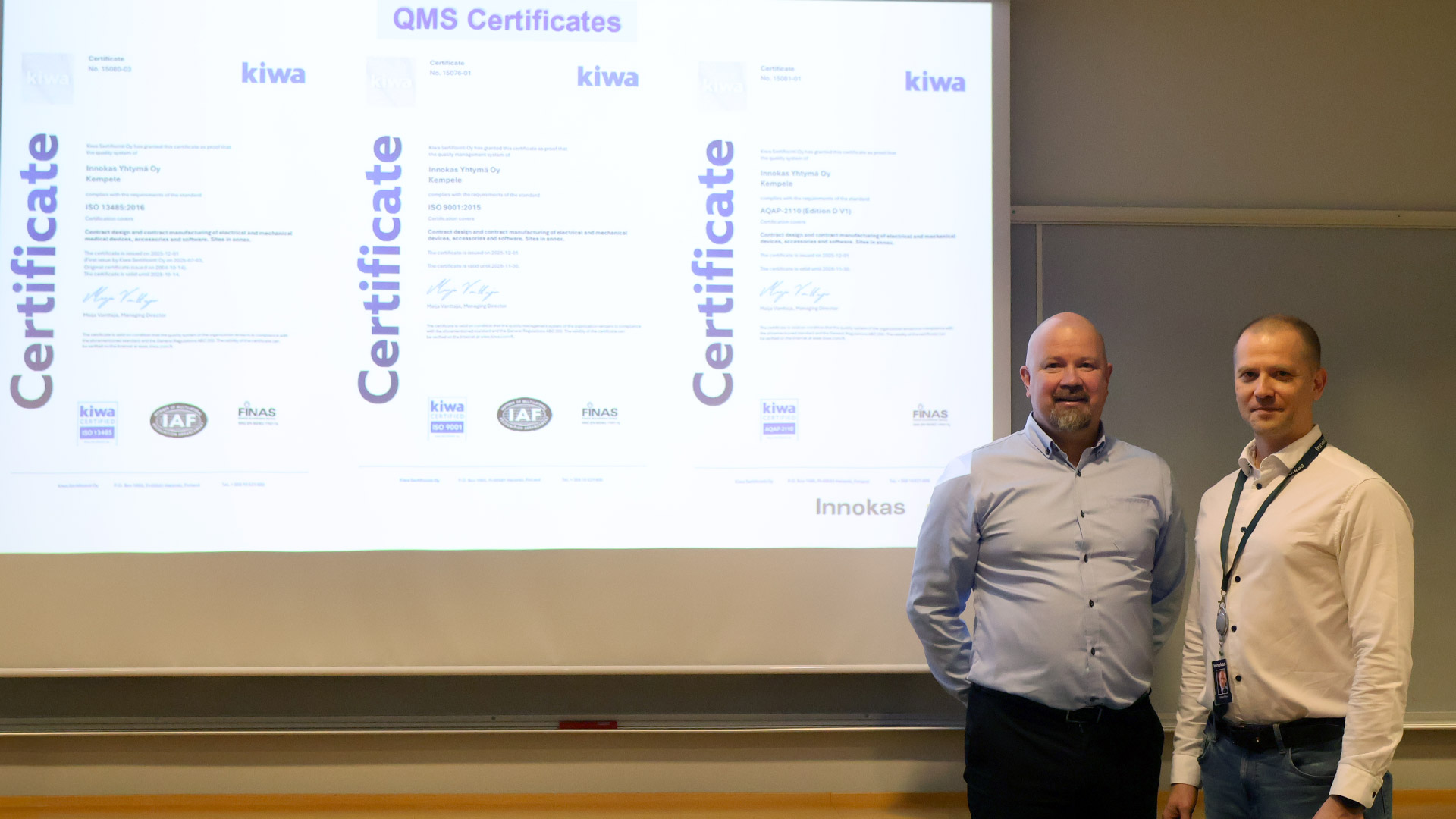
In regulated industries, a quality management system is part of the production infrastructure. Standardized, well-documented processes reduce unnecessary variation and support consistent output. They also make onboarding faster, which matters when production volumes rise, and headcount needs to follow. Documentation and traceability are non-negotiable. Every unit produced generates a document trail, and as volumes grow, so does the resource required to maintain it properly.
Process discipline pays off in this phase. Automating parts of the reporting workflow, minimizing duplicate record-keeping, and aligning practices across shifts and sites can all reduce administrative bottlenecks without compromising the auditability that demanding customers and regulators expect. A robust quality system also ensures successful change management and process validation, regardless of the size of production or production batches. The companies that scale quality successfully tend to treat their QMS as something that evolves alongside production instead of something set up once and left to run.
Capacity ultimately depends on people, perhaps more than anything else. Skilled operators, test specialists, supply chain professionals, and production managers all determine how quickly and reliably a company can ramp up. In the Nordic market, where specialised labour can be limited, access to existing capabilities can make a significant difference.
For companies seeking a Nordic manufacturing partner, the right support can shorten the path from market entry to stable production. It can also free internal teams to focus on product strategy, customer needs, and future development rather than building every operational capability from scratch.
If your company is looking for production capacity, product development support, or development resources in Finland or the Nordics, we are ready to do low-threshold scaling project with you to increase your understanding of the process and what it will require.
Innokas has supported technology companies with contract manufacturing, electronics manufacturing, product development, DfX, production testing, and quality and regulatory expertise backed up by over 30 years of experience in regulated, quality-critical products. If you are looking for a practical route from ambitious technology to scalable Nordic production, fill out our contact form below.

Here you can find more of our latest news and insights in this category.
Here you can find more of our latest news, tips and insights.
.jpg)
Here you can find more of our latest news and insights.
Here you can find more of our insights, news and tips.

Here you can find more of our insights, news and tips.
.jpg)





.jpg)






.jpg)